
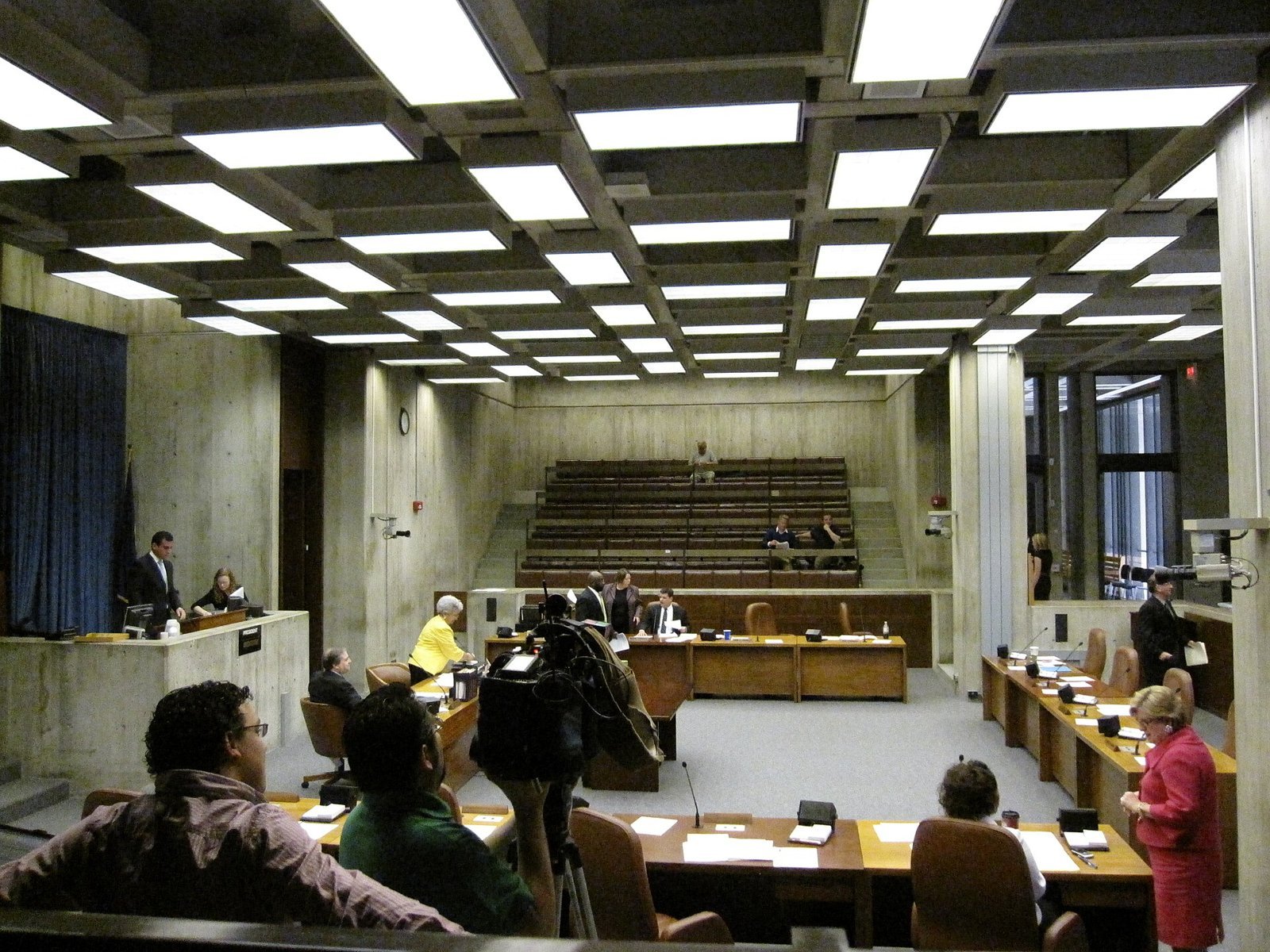
Developers building new homes in most of Boston would no longer be required to include a set number of off-street parking spaces under a measure the City Council passed Wednesday after hours of tense debate.
The council voted 9-4 to strike the minimum parking requirements from the city’s zoning code for new residential development, the Boston Globe and WBUR reported. Councilor Julia Mejia first voted present, then changed her vote to yes at the end of the meeting. The measure now goes to the Boston Zoning Commission, which must approve the change before it takes effect.
What would change
Today the required number of spaces depends on the neighborhood and ranges from half a space to two spaces per unit, according to WBUR. The amendment would let developers decide how much parking a project needs based on demand, financing and accessibility. It does not ban parking.
Boston has already dropped the requirement in some places. In 2021 the city eliminated parking minimums for developments in which at least 60% of the units are affordable, WBUR reported, and minimums have also been removed downtown and in commercial areas of East Boston, Mattapan, Roslindale and Hyde Park, according to the Globe. Large projects of more than 50,000 square feet already go through the city’s Article 80 review, where parking is set case by case, Bisnow reported.
Before the vote, lead sponsor Sharon Durkan, whose district includes Back Bay, Beacon Hill and Fenway, amended the measure to delay it until Jan. 1, 2029, in East Boston, Charlestown and Mattapan. Those neighborhoods went through their own rezoning in recent years. Councilor Gabriela Coletta Zapata, who represents East Boston and Charlestown, pushed for the delay. Other amendments, including proposals to exempt Dorchester and Roxbury, failed.
The case for the change
Supporters say parking is one of the most expensive parts of a housing project and that renters and buyers end up paying for it. The city estimates a single garage space can cost up to $50,000, WBUR reported. A Pioneer Institute study cited by the Globe put the cost at $34,000 to $152,000 per space, depending on whether it is above or below ground. A 2019 Metropolitan Area Planning Council report found that 30% of spaces in Boston and 20 surrounding communities sat empty at peak hours, the Globe reported.
“We cannot afford to move neighborhood-by-neighborhood pace while rents continue to climb,” Durkan said during the meeting, according to the Globe and Bisnow. “This is not a silver bullet, but it’s a common-sense reform within our control.”
Durkan and Councilor Henry Santana filed the petition in April, Bisnow reported. Groups backing it include the Greater Boston Real Estate Board, the Commercial Real Estate Development Association, Abundant Housing Massachusetts and the Environmental League of Massachusetts Action Fund. Cambridge and Somerville have dropped parking minimums citywide, and Salem did the same in 2025.
The case against
Murphy called the measure a “blanket approach” that “fails to recognize the different needs our neighborhoods have.” She added: “For many residents, driving remains a necessity, not a luxury.”
“Residents shouldn’t be punished for owning a car,” Flynn said, according to Bisnow. Opponents also raised concerns about spillover onto already crowded streets and about residents with disabilities who rely on personal vehicles, WBUR reported. Mejia said the council needed more clarity on whether savings from skipping parking would actually translate into more affordable housing.
Mayor Michelle Wu’s office did not say whether she supports the measure. “Our neighborhood by neighborhood approach has enabled zoning changes that fit each community’s needs while reducing barriers to development,” spokesperson Marcela Dwork said in a statement. “We will evaluate the implications of eliminating parking minimums citywide.”
Also at the council: Eng agrees to appear
The council also ended its standoff with MBTA General Manager Phil Eng. Councilor Miniard Culpepper withdrew his push to enforce a subpoena after Eng agreed to attend a Dec. 7 council working session on the planned redesign of Blue Hill Avenue, which includes center-running bus lanes, WBUR and the Globe reported. Eng had not appeared at earlier sessions on Oct. 14 and Nov. 6.
Sources
- Boston Globe: In divided vote, Boston City Council passes measure to eliminate minimum parking requirements for new housing developments (Nov. 18, 2026)
- WBUR: Boston moves to eliminate off-street parking requirement for new housing (Nov. 18, 2026)
- Bisnow: Boston City Council Votes To Eliminate Parking Minimums For New Housing Development (Nov. 18, 2026)
- WBUR: Eng agrees to meet with Boston City Council, ending subpoena standoff (Nov. 18, 2026)
- City of Boston: City Council meeting, Nov. 18, 2026 (Legistar)