
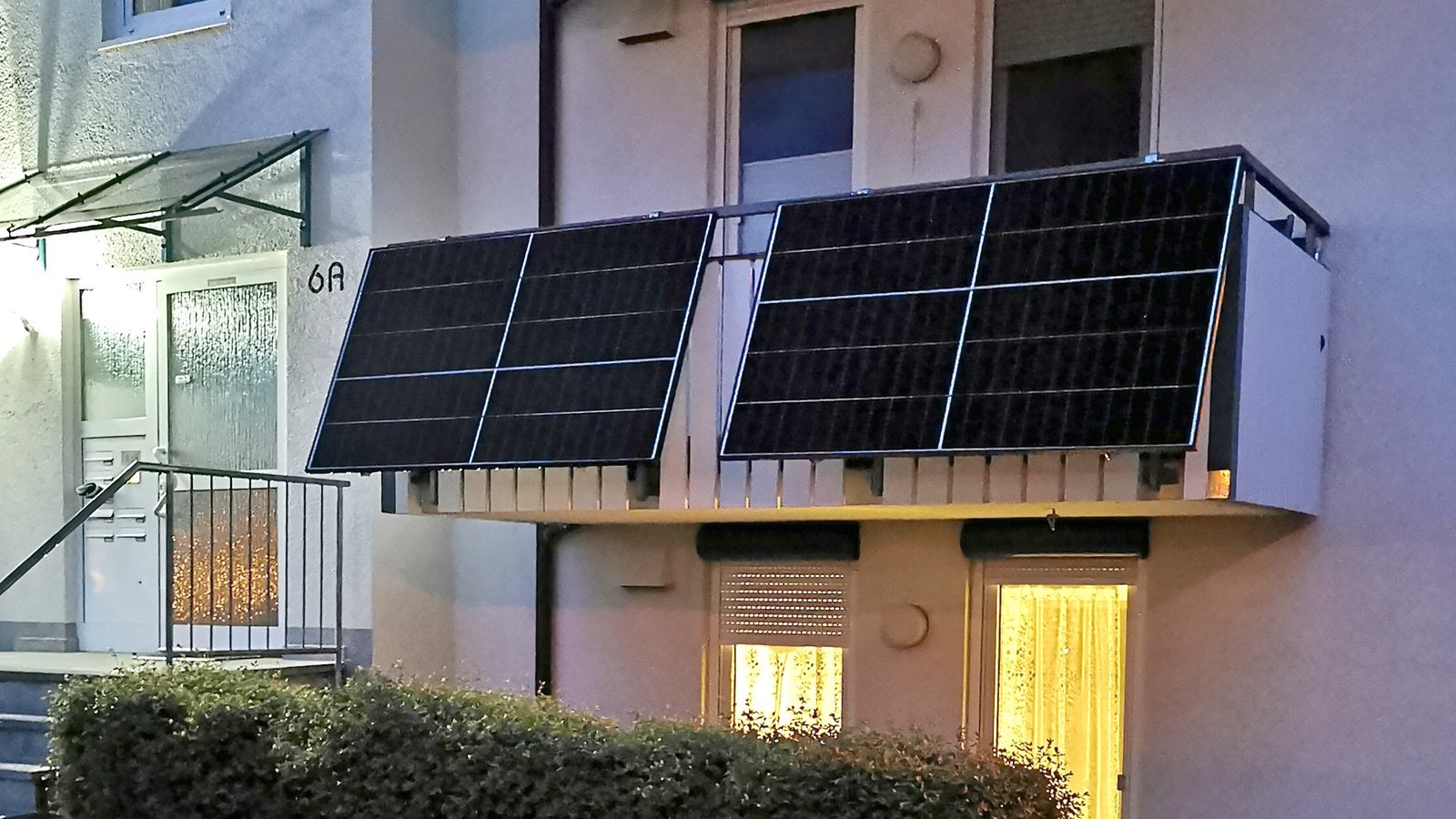
Small solar kits that hang on a balcony railing and plug into an ordinary outlet are spreading across U.S. statehouses. In Massachusetts, the idea has passed both the House and the Senate, but it is not law yet.
What plug-in solar is
Plug-in or balcony solar systems plug into a power outlet like an appliance. Instead of drawing power from the building, they supply it for use elsewhere in the home, State House News Service reported, citing the Clean Energy States Alliance. They are generally not mounted on roofs and are small enough that people with little technical expertise can set them up.
A typical system pairs one or two panels with a microinverter that turns the panels' direct current into household alternating current. The power is used first by whatever is running in the home, such as a refrigerator or router, which cuts how much electricity the household buys from the utility. The setups are common in Germany, where they are known as Balkonkraftwerke, or balcony power plants.
Where Massachusetts stands
Plug-in solar is part of a much larger bill, An Act relative to energy affordability, clean power and economic competitiveness. The House passed its version, H.5175, 128-27 on Feb. 26. The Senate passed its own version 32-8 on July 1, according to the Legislature's official bill history.
On July 16, the House rejected the Senate's changes and both chambers appointed a six-member conference committee: Reps. Mark Cusack, Aaron Michlewitz and Bradley Jones and Sens. Michael Barrett, Cynthia Creem and Bruce Tarr. As of Sunday, the bill history lists no conference report, and the bill has not reached Gov. Maura Healey.
The two chambers took different approaches. The Senate version would let plug-in systems up to 420 watts be installed without an electrician or any utility sign-off. Systems up to 1,200 watts would require a licensed electrician and a notice to the utility. It would also bar utilities from blocking compliant systems or requiring studies, approvals or fees, State House News Service reported. The House bill also authorized plug-in solar, using a different approach. The final rules, including the size limit, will not be known until negotiators release a compromise.
What the rules are today
For now, Massachusetts treats a solar device that feeds a home's wiring like any other generator connected to the grid. Before connecting, the owner must get written approval from the local utility in the form of an interconnection service agreement and an authorization to connect, according to the state's guidance on utility interconnection. The Department of Public Utilities requires Eversource, National Grid and Unitil to follow standardized interconnection tariffs.
Small inverter-based systems qualify for the utilities' simplified process. Eversource lists a $0 application fee for most small single-phase systems on ordinary radial circuits, but it is still an application. Plugging in an unapproved grid-tied kit could put a customer at odds with the utility's rules, so anyone who wants one now should contact Eversource or National Grid first.
Setups that never connect to home wiring are a different story. A portable panel that charges a battery power station, which then runs devices plugged into it, does not feed the grid.
How other states are doing it
Utah was first. Its 2025 law, HB 340, took effect May 7, 2025. It covers portable solar devices of up to 1,200 watts that connect through a standard 120-volt outlet, meet the latest National Electrical Code and are certified by Underwriters Laboratories or an equivalent lab. Those devices are exempt from interconnection agreements, and utilities may not require approval, fees or extra equipment. Each device must include a feature that keeps it from energizing the building's wiring during a power outage.
Even there, the rollout has been bumpy. Rocky Mountain Power, Utah's largest utility, says that based on its reading of the law, no manufacturer's product appears to fully meet both the code and certification requirements.
Other states followed in 2026. By September, Colorado, Connecticut, Maryland, New Hampshire, New Jersey, Maine, Utah, Vermont and Virginia had signed balcony solar laws, PV Tech reported, with California and New York bills awaiting final action at the time.
The safety standard
UL Solutions launched a testing and certification program for plug-in solar based on UL 3700, its Outline of Investigation for Interactive Plug-In Photovoltaic Equipment and Systems. The company says the standard requires features that guard against contact with live parts, protect against circuit overloads and prevent power from flowing back into utility lines.
Why fans love it
The biggest selling point is access. Rooftop solar mostly works for people who own a house with a good roof. Plug-in kits can work for renters, condo owners and apartment dwellers with a sunny balcony, porch or yard. UL Solutions says certified systems could suit renters and homeowners who cannot install rooftop systems.
They are also simpler and far smaller investments than rooftop solar: no roof work, no long permitting process in states with plug-in laws, and a system that can move with you. Massachusetts residents pay some of the highest electricity prices in the country, according to the U.S. Energy Information Administration, so every kilowatt-hour made at home is worth more here than in most states.
Savings depend on how much sun the panels get, which way they face and how much power the home uses while the sun is up. Most state laws, like Utah's, do not pay owners for extra power sent to the grid, so the value comes from electricity used as it is made.
What to check before you buy
Look for a system certified by UL or another nationally recognized testing lab, ideally to UL 3700, with built-in protection that shuts it off when the grid goes down. Plug it into a suitable outlet on its own, not a power strip or extension cord, and check what else runs on that circuit. Read your lease or condo rules, since nothing in Massachusetts law currently overrides them. Ask your utility before connecting a grid-tied kit, and watch for the final energy bill, which could change the rules.
Sources
- Massachusetts Legislature: Bill H.5175 history
- State House News Service: House, Senate aligning around plug-in solar policies (June 25, 2026)
- Mass.gov: Utility interconnection in Massachusetts
- Eversource: Massachusetts application to interconnect
- Utah Code 54-15-601 (HB 340, 2025)
- Rocky Mountain Power: Portable solar generation (plug-in solar)
- PV Tech: US plug-in solar, a state-by-state race to clear regulatory hurdles
- UL Solutions: Testing and certification framework for plug-in solar
- U.S. Energy Information Administration: Massachusetts electricity profile