
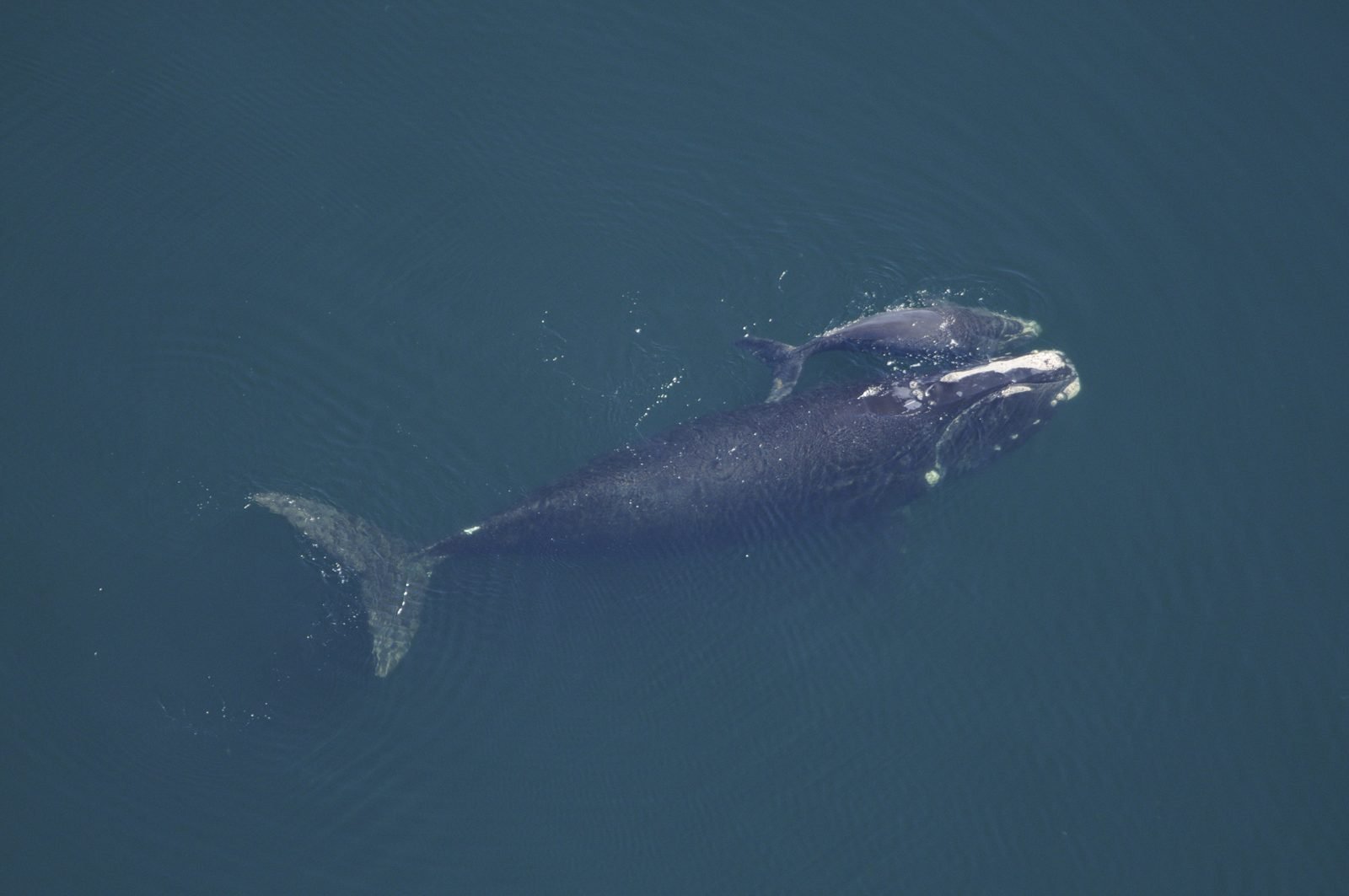
The population of critically endangered North Atlantic right whales, which give birth off the southeastern U.S. and travel north to feed in New England and Canadian waters, including Cape Cod Bay, slipped slightly in 2025, according to the latest estimate released Monday.
The North Atlantic Right Whale Consortium put the 2025 population at 382 whales, with a margin of error of plus or minus 11. That is a 1.8% decline from the 2024 estimate, which was recalculated from 384 to 389 as new data came in. The estimated number of reproductive females held steady at 73. Scientists from the New England Aquarium’s Anderson Cabot Center for Ocean Life on Central Wharf and the National Oceanic and Atmospheric Administration worked together on the count, which was released as the consortium opened its annual meeting Nov. 16 and 17 in Halifax, Nova Scotia.
The 2025 estimate is 20% below the population’s high of 483 in 2011, according to the aquarium.
The trend is the worry
Because the new figure falls within the margin of error, Heather Pettis, who leads the aquarium’s right whale research program and chairs the consortium, told WBUR that “it’s not the number itself that is cause for alarm.” The concern, she said, is “that lack of sustained growth, combined with continued injuries and mortalities from entanglements and vessel strikes.”
“The population is not yet on a clear path to recovery and is incredibly vulnerable to entanglements and vessel strikes, threats we know how to reduce,” Pettis said in the aquarium’s announcement.
Mark Baumgartner, a whale ecologist at the Woods Hole Oceanographic Institution who did not work on the estimate, told WBUR that 73 reproductive females “is a really low, low number.” With one catastrophic accident or a couple of years of poor feeding, he said, “this population can slide into extinction very, very fast.”
A record calf season
There was good news from the calving grounds. The 2025-2026 calving season produced 24 calves, the most since 2009, including a late arrival first seen in Canadian waters in September. Three of the mothers were giving birth for the first time. The International Fund for Animal Welfare said no calf deaths were documented, and that the new births are not yet reflected in the 2025 estimate.
“With 24 calves born this year, the whales are doing their part,” said Philip Hamilton, a senior scientist at the aquarium. Lindsey Jones, who manages the North Atlantic Right Whale Catalog at the aquarium, said population growth “depends on every calf being able to reach maturity free from human-caused harm.” WBUR reported that the next season is already underway, with the first calf spotted off Florida on Nov. 10.
Deaths and injuries in 2026
Two right whale deaths have been detected so far this year. The carcass of a 4-year-old male known as Division was found off North Carolina on Jan. 27 after a serious entanglement traced to Canadian snow crab gear. A 3-year-old female was found dead on a barrier island off Virginia on Feb. 10, and her cause of death is unknown. Scientists have also documented eight human-caused injuries this year: seven entanglements and one vessel strike.
The policy fight
The aquarium said the deaths and injuries come amid efforts to roll back protections, including a congressional bill that would extend a pause on additional whale protections until 2035 and regulatory changes that weaken the Endangered Species Act. WBUR reported that the U.S. House passed a bill in September that would delay certain right whale protections for several years.
Fishing groups have pushed back on tighter rules. “In Massachusetts, we are under the most restrictive conservation rules anywhere, and we have not had one death attributed to Massachusetts commercial lobster gear,” Beth Casoni, executive director of the Massachusetts Lobstermen’s Association, told WBUR.
The consortium will publish a full annual report on the species early in 2027.
Sources
- New England Aquarium: North Atlantic right whale population continues to struggle in latest update on the critically endangered species (Nov. 16, 2026)
- WBUR: Right whale population dropped in 2025 after a few years of growth (Nov. 16, 2026)
- IFAW: North Atlantic right whale population dips slightly as conservation efforts remain critical (Nov. 16, 2026)
- Oceanographic: North Atlantic right whale population slips to 382 (Nov. 16, 2026)
- North Atlantic Right Whale Consortium: Interactive report card