
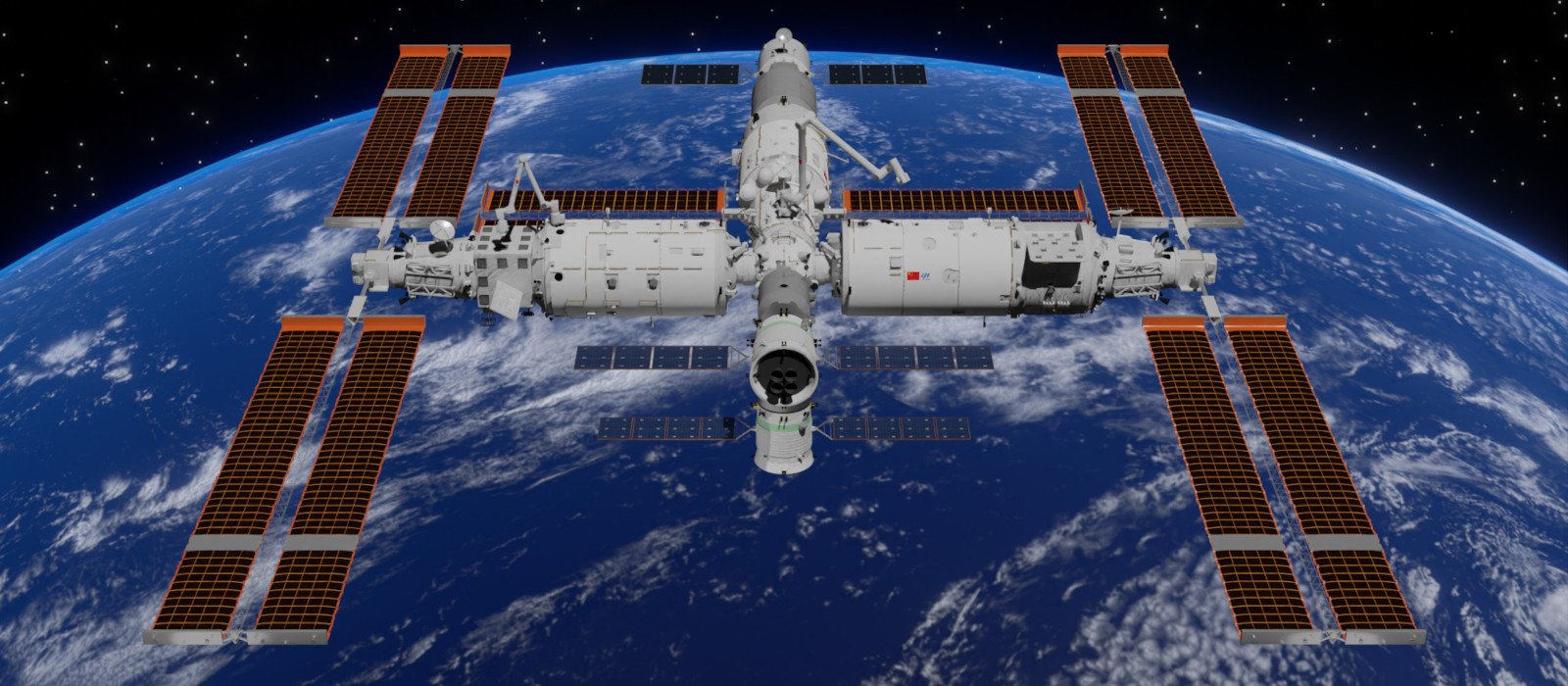
Chinese scientists have cooled rubidium atoms to 9.7 picokelvin aboard China’s space station, the lowest temperature ever reported, and kept the sample stable long enough for 7 seconds of observation, Xinhua reported Friday.
A picokelvin is one trillionth of a degree above absolute zero. The team used the station’s ultra-cold atom physics rack. The work appears in Science under the title “Quantum gases below 10 picokelvin in space” (DOI: 10.1126/science.aea5324) and was announced at a Chinese Academy of Sciences briefing on the space station program.
Beating the 2021 record
The previous mark was 38 picokelvin, set by a German team in 2021. Xinhua said the China station experiment more than halved that temperature while stretching usable observation time far beyond what ground labs and the International Space Station typically allow.
On the ground, similar systems often support only about 0.05 seconds of observation. On the ISS, about 1 second has been typical. The China station rack reached about 7 seconds, according to Xinhua.
How they did it
The project’s feasibility work began in 2011. The flight system launched with the Mengtian module in 2022. Peking University and the Shanghai Institute of Optics and Fine Mechanics of the Chinese Academy of Sciences led the science, organized by the Technology and Engineering Center for Space Utilization under CAS.
The method relies on an all-optical trap, evaporative cooling and non-adiabatic diffusion, rather than magnetic-trap approaches used in some earlier ultra-cold experiments, Xinhua reported.
Engineers compressed a ground system that filled about 20 cubic meters and weighed about 10 tonnes into a rack of roughly 0.7 cubic meters and 0.5 tonnes so it could fly on the station.
Why colder, longer matters
Ultra-cold atoms are a tool for quantum simulation, atomic clocks, atom interferometry and quantum computing. Xinhua said the colder, longer-lived samples could also support research into early-universe physics and ultralight dark matter.
The result underscores how microgravity on a dedicated station rack can stretch the window for measuring quantum gases that vanish quickly under Earth gravity.